
No Lock-side battery · no wiring · phone-powered NFC
Battery-Free Smart Lock — NFC Powered Locks, APP based access
KENRONE combines battery-free smart lock hardware with smartphone unlocking, app-based authorization and access records. At the tap, the phone NFC provides both the power and the credential, so the lock itself needs no built-in battery, wiring or gateway to open.

Smart Access Platform
Real-time management
Reduce Life-Cycle Cost
Quick and Easy Renovation
ODM OEM
How it works
One Tap Powers and Verifies the Lock
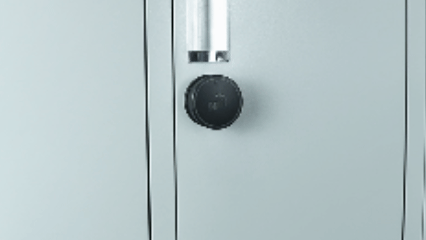
An authorized user opens the KENRONE app and places an NFC-enabled phone against the lock's NFC area. Within 1 cm—normally with the phone touching the lock—the phone energizes the electronics, the lock verifies permission and the mechanism releases. The current generation typically completes the sequence in 0.5–2 seconds under suitable phone, placement and authorization conditions.
01
Assign access — Add, change or revoke user permissions in the KENRONE app or connected management system.
02
Tap the lock — The smartphone supplies energy and an encrypted credential over NFC.
03
Verify and open — The lock verifies permission locally and releases; supported deployments retain an unlock record.
Why upgrade
What are the benefits of using a battery-free smart lock?
KENRONE NFC battery-free locks are built for real projects. With faster unlocking, competitive factory pricing, and a growing product line, we help customers find a practical lock solution for more applications.
Reduce Key Management
Move away from distributing, collecting, and tracking large numbers of mechanical keys.
Avoid Lock-Body Battery Maintenance
The lock itself does not rely on a built-in battery, helping reduce repeated battery checks across multiple locking points.
Make Access More Flexible
Use mobile authorization to support different users, changing tasks, and temporary access needs.
Improve Traceability
Unlocking actions can be managed and reviewed through the system, making access easier to follow.
The hardware layer
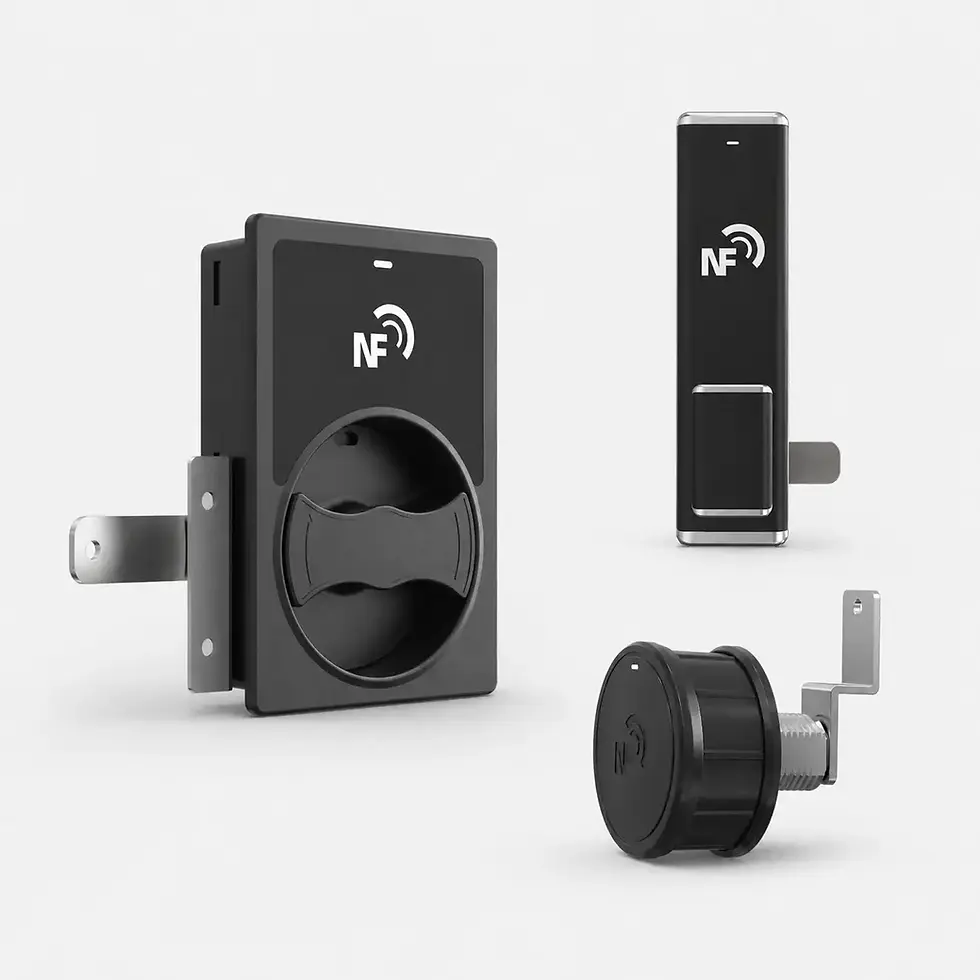
Multiple Battery-free Smart Lock Formats
Choose the hardware that matches the opening; keep one battery-free NFC access approach across the project.


Smart Euro Cylinder Lock
Compatible Euro-profile door retrofits

Storage Unit Cylinder Lock
Compatible self-storage door hardware

Storage Disc Padlock
Storage-unit hasps and disc-lock applications

Bike Cable Lock
Managed bicycle and light-mobility parking

Key Lock Box
Controlled access to stored physical key
inside the system
What the Battery-Free Smart Locking System Does
The KENRONE app and management platform support user authorization, permission changes and unlock records. Documented API and SDK resources are available for qualified integration projects. Offline unlocking can be supported by the deployment design; confirm the required authorization and synchronization workflow during specification.

Authorization Layer
App / management
Access is assigned, changed, and removed through the App or management system — across different users, tasks, and temporary needs.
Records Layer
Traceability
Unlocking events can be recorded, managed, and reviewed, so access across many locks and users stays easier to follow.
Integration Layer
API & SDK
An open platform with documented API and SDK, so integrators and OEM partners can connect the locking layer into their own systems.
Open integration
Manufactured for Integration and OEM Projects
KENRONE has worked in locking products since 2002 and has focused on battery-free NFC locks since 2020. Product design, manufacturing, assembly and testing are supported from our Huizhou facility. We work with lock brands, cabinet and locker manufacturers, integrators and project buyers on standard products and qualified OEM/ODM programs.
// open integration platform
API documented endpoints
SDK for app & system integration
connect → your own management platform
// no closed-app workaround


Residential Properties

Secure Storage Products


Choosing a method
Mechanical Locks, Battery-Powered Smart Locks, or NFC Battery Free Smart Locks?
Different locking methods solve different problems. The right choice depends on how many locks you manage, how often access changes, and how much maintenance your project can accept.
Comparison term | Mechanical Locks | Battery-Powered Smart Locks | NFC Battery-Free Locks |
|---|---|---|---|
Better for | Simple use | Feature-rich smart access | Commercial low-maintenance digital locking |
Unlock records | No | Depends on system | Can be supported |
Digital authorization | No | Usually yes | Yes |
Battery maintenance | None | Required | No battery inside the lock |
Key management | Higher | Lower | Lower |
Lock-body battery | No | Yes | No |
Unlocking | Physical key | App / code / card / fingerprint | Smartphone NFC |
Why KENRONE
Discover KENRONE. Choose with Confidence.
KENRONE has years of experience in locking products, from mechanical locks to electronic and battery-free systems. We focus on making NFC locking practical for real commercial projects, not just adding smart features for the sake of it.
Built on long-term work in mechanical, electronic, and battery-free locking products.
We develop locks and related products around a clear low-maintenance direction.
Key design, manufacturing, and quality processes are managed within KENRONE.
We help customers match lock formats, applications, and access workflows more clearly.

clear advantage
We have a Clear Advantage in the field of NFC Battery-Free Smart Lock
KENRONE NFC battery-free locks are built for real projects. With faster unlocking, competitive factory pricing, and a growing product line, we help customers find a practical lock solution for more applications.
Faster Unlocking
Recent technical upgrades have greatly improved the unlocking speed.
Better Value
As a manufacturer, we offer competitive pricing while keeping quality under control.
More NFC Lock Options
Our NFC battery-free lock series continues to expand for cabinets, padlocks, lock cylinders, cable locks, and custom projects.
News & Blog
Related Resources


